


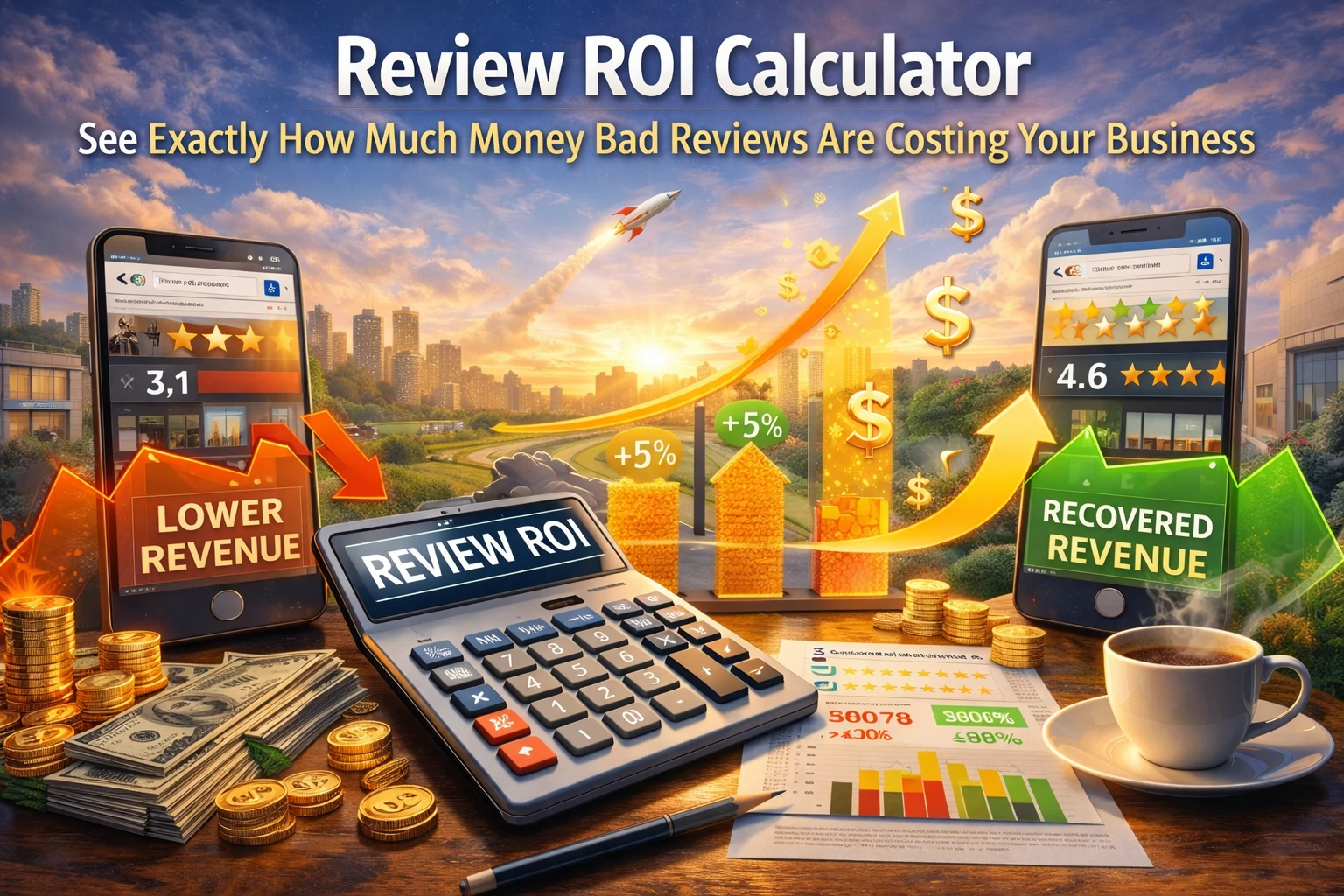
Review ROI Calculator: See Exactly How Much Money Bad Reviews Are Costing Your Business
A 3-star business usually isn’t “bad.” It’s uncertain.
And uncertainty is poison online.
Because when a customer sees 3.1 stars, they don’t think, “Maybe it’s fine.” They think, “Risk.” Then they keep scrolling.
The good news is this: you don’t need a year to change your trajectory.
You need a 7-day sprint that does three things at once:
- Fix the real problems that create 3-star experiences.
- Remove friction so happy customers actually leave feedback.
- Build momentum with fast, professional responses and consistent follow-through.
Before You Start: The Compliance Line You Cannot Cross
Quick disclaimer: this article is general information, not legal advice. Always review the latest policies for your accounts and industry.
Many businesses try to “speed-run” reviews by trading discounts, freebies, or services in exchange for reviews.
That’s risky.
- Google: Google’s policies prohibit offering incentives (including free goods/services) in exchange for reviews, revisions, or removal of negative reviews. (Example policy reference: Google Maps user-contributed content policy)
- Yelp: Yelp’s guidance is “Don’t Ask for Reviews,” and it also prohibits solicitation and incentives. (Example policy references: Yelp Support and Yelp solicitation penalty)
- Instagram / social proof: If a testimonial or endorsement involves a “material connection” (free product, discount, perk), disclosure should be clear and easy to notice. (Example FTC references: FTC Endorsement Guides FAQ and FTC Disclosures 101)
The smart play: build a clean “customer appreciation + feedback engine” that stays defensible.
- You can reward customers for being customers.
- You can reward customers for private feedback.
- You can ask for Google reviews without incentives attached.
- For Yelp, focus on experience and visibility, not solicitation.
- For Instagram testimonials/UGC, disclose perks when applicable.
Why 7 Days Works
Because reviews behave like momentum.
When you respond quickly, improve visibly, and start collecting feedback consistently, you change what new customers see:
- More recent reviews.
- Better owner responses.
- More proof your business is alive and improving.
- Less fear.
Even if your average rating doesn’t jump overnight, the story changes fast.
Day 1: Find the 3-Star Pattern (It’s Usually Only 2–3 Issues)
Most 3-star businesses aren’t failing at everything. They’re failing at a few repeatable moments.
- Pull your last 30 reviews across Google and Yelp.
- Put every complaint into buckets:
- Wait time / scheduling
- Communication
- Pricing surprise
- Staff attitude
- Quality inconsistency
- Cleanliness / environment
- “Not as described”
- Count them. Pick the top two.
Then choose one improvement you can implement in 24 hours. Not next month. Tomorrow.
Day 2: Make Your Profiles Look Like a 5-Star Business
Before customers read reviews, they scan the profile. Tighten the basics.
Google Business Profile
- Correct categories, services, hours, and service area.
- Add 10–20 high-quality photos (real, current, well-lit).
- Add a short description: what you do, who it’s for, and why trust you.
- Enable messaging only if you can respond quickly.
- Add FAQs based on recurring questions.
Yelp
- Claim and complete the profile.
- Add accurate business info and strong photos.
- Keep your NAP consistent across the web (name/address/phone).
- Pin 3 posts that show:
- What you do.
- Proof (results, before/after, behind-the-scenes).
- A trust builder (team, process, standards, guarantees).
Day 3: The Response Sprint (Fastest Reputation Lift)
A perfect response won’t erase a bad review. But it will reassure the next 50 readers.
- Respond to every 1–3 star review from the last 12 months.
- Respond to every 4–5 star review from the last 30 days.
Keep responses calm, specific, short, and solution-forward.
Simple response framework:
- Thank them.
- Validate the emotion.
- State what you changed (only if true).
- Invite offline resolution.
Example: “Thanks for the feedback, [Name]. I’m sorry the wait ran long that day. We’ve adjusted our scheduling buffer so appointments don’t stack the same way. If you’re open to it, I’d like to make this right—please reach us at [phone/email] and ask for [manager].”
New rule: respond to all new reviews within 24–48 hours.
Day 4: Build the Google Review Flow (No Incentives. No Weirdness.)
Google is where you can run a clean, consistent review ask, as long as you do not attach incentives.
Step 1: Make it effortless
- Use your direct Google review link.
- Convert it into a QR code.
- Place it on receipts, a countertop card, and in follow-up messages.
Step 2: Ask at the right moment
Ask when the customer’s “win” is highest: right after a successful outcome, right after they thank you, or right after you fix a mistake well.
Step 3: Use a simple staff script
“If you were happy with us today, would you mind leaving an honest Google review? It really helps local businesses like ours.”
Step 4: Send one follow-up message
Send it 2–6 hours later. Keep it short.
“Thanks again for coming in today. If you have 30 seconds, an honest Google review helps us a ton: [link]”
Day 5: Treat Yelp Differently (Because Yelp Is Different)
Yelp’s guidance is simple: don’t ask for reviews. So don’t try to “generate” Yelp reviews.
Instead, do the things that win Yelp users when they are already searching:
- Deliver a consistent experience.
- Keep your Yelp page accurate, complete, and photo-rich.
- Respond professionally to reviews.
- Make it easy to find your Yelp listing for people who use Yelp.
Day 6: Turn Instagram Into Your Proof Engine (Disclose Perks When Needed)
Instagram isn’t a star-rating platform like Google. But it is a trust amplifier.
Three easy wins
- Story screenshots (with permission): share customer messages or short testimonials.
- Simple UGC ask: “If you share a quick story and tag us, we’ll repost it.”
- Pin proof: one “Results” post, one “How we work” post, one “Customer love” post.
If you gave a freebie, discount, or perk in connection with the post, make sure disclosure is clear and easy to notice.
Day 7: Launch the “Feedback Swap” (The Ethical, Platform-Safe Version)
Let’s keep your business model in context.
You offer a service that helps businesses “swap” value for reviews across Google, Yelp, and Instagram.
The safest way to do that is to swap value for private feedback and optional social proof, while keeping public review platforms clean.
A compliant “swap” structure
- Swap value for a short private feedback survey (service credit, upgrade, free add-on, bonus).
- Separately invite the customer to leave an honest Google review, with no incentive attached.
- Do not ask customers to leave Yelp reviews.
- For Instagram testimonials/UGC tied to perks, use clear disclosures.
This approach gives you:
- Fast insight into what’s creating 3-star experiences.
- More “fix opportunities” before issues become public.
- More momentum on Google without risky shortcuts.
- More trust content on Instagram.
The Math That Makes This Real
If you have 100 reviews at 3.0 stars, you have about 300 “star points.”
If you add 50 new 5-star reviews (250 star points), you’d have:
- 150 reviews
- 550 star points
550 / 150 = 3.67 stars
So yes, momentum can change quickly. But true transformation takes volume and consistency.
That’s why this is not a “rating hack.” It’s a trajectory flip.
The 5-Star Powerhouse Checklist (Run Weekly)
- Respond to every review within 48 hours.
- Ask every happy customer for an honest Google review (without incentives).
- Never “gate” who you ask based on positivity.
- Use private feedback surveys to catch issues early.
- Improve one recurring pain point per week.
- Update photos monthly.
- Post proof weekly on Instagram (and disclose perks when applicable).
- For Yelp: don’t solicit; focus on service quality and profile hygiene.
Where Our Service Fits (Without Crossing Lines)
If you want a fast, organized way to run this 7-day sprint, our “review swap” approach is built to be compliance-first: we help you exchange value for private feedback and customer appreciation, automate follow-ups, and build repeatable workflows that improve experience and increase legitimate review momentum.
Tip: position your offer as “customer appreciation + feedback” rather than “free stuff for reviews.” It protects your listings and protects your brand.
Closing: The Real Secret
A 5-star business isn’t a business with no problems.
It’s a business that fixes problems faster than customers can complain about them.
So don’t chase perfection. Chase momentum.
Because when customers feel improvement, they forgive the past. And when they see consistency, they reward you with trust.